Setting up Shopify shipping in Pakistan ready requires ignoring the default international settings and focusing entirely on Cash on Delivery (COD)
Shopify’s default shipping settings are built for USPS and FedEx. If you try to run a Pakistani store using those default settings, you will drown in manual data entry — wrong shipping zones, currencies that don’t match your customers, and rate structures that make no sense for local delivery.
Here is the good news: the days of manually writing waybills or copy-pasting tracking numbers are over. Today, local tech-first couriers offer direct Shopify integrations that automate the entire Cash on Delivery workflow — from order placement to waybill generation to customer tracking updates.
This guide covers exactly how to configure your Shopify shipping zones, structure your flat rates correctly, and install local courier apps so your fulfillment runs on autopilot instead of manual data entry.
If you haven’t chosen a payment method yet, read our guide on the best payment gateways for Shopify in Pakistan before setting up shipping — your payment and shipping setup work together, especially for COD orders.
Table of Contents
Why Pakistani Shopify Shipping is Unique — The COD Factor
Over 70% of the Pakistani eCommerce market is widely reported to run on Cash on Delivery. This single fact changes everything about how shipping works here compared to international stores.
When you ship a product in Pakistan, the courier is not just delivering a parcel — they are acting as your payment collector. The courier collects cash from the customer at the doorstep and reconciles that payment back to you. This is fundamentally different from how shipping works in markets where customers pay upfront online.
This is exactly why your payment setup and shipping setup are connected. If you have not yet configured your payment methods, read our complete guide on the best payment gateways for Shopify in Pakistan before continuing here.
Because of this COD-first reality, your shipping configuration needs to account for verification, return handling, and courier reconciliation — not just delivery speed.
Step 1 — How to Set Up Shopify Shipping in Pakistan
This is the foundational setup every Pakistani Shopify store needs.
Steps:
- Go to Settings → Shipping and delivery
- Click “Create shipping zone”
- Name it “Pakistan”
- Add Pakistan as the country
- Save
[SCREENSHOT: Shopify Shipping Zones settings page]
Crucial step most beginners miss: Delete the default international shipping zones that Shopify sets up automatically. If you leave the “Rest of World” zone active with default rates, you risk getting orders from customers in the US, UK, or elsewhere that you have no way to actually fulfill. Go through your shipping zones and remove anything outside Pakistan unless you have specifically planned for international fulfillment.
Step 2 — Choosing Your Shipping Rate Structure
You have three options for structuring your shipping rates. For most Pakistani stores, one of these is clearly the right starting point.
Flat Rate (Recommended for Most Stores)
A fixed shipping fee regardless of order size. This is the standard approach for Pakistani eCommerce.
The current standard flat rate in Pakistan hovers between Rs. 150 to Rs. 250 per kg, depending on your courier and negotiated volume. For most new sellers, setting a flat rate of Rs. 200 is a safe, simple starting point that covers standard apparel, accessories, and small product shipments.
Price-Based Free Shipping
Offer free shipping above a certain order value — for example, “Free shipping on orders over Rs. 3,000.” This is a proven tactic to increase your average order value, since customers will often add an extra item to qualify for free delivery.
Weight-Based Rates
Only use this if you are selling genuinely heavy or bulky items — furniture, appliances, large home goods. For standard apparel, cosmetics, or dropshipping products, weight-based rates add unnecessary complexity to your checkout and can confuse customers. Stick to flat rate unless your product category specifically requires weight tiers.
Shipping Profiles: If you sell a mix of light and heavy products, Shopify lets you create separate Shipping Profiles — one flat rate for standard items, a different weight-based rate for bulky products. This is set up under Settings → Shipping and delivery → Manage rates.
Step 3 — Best Courier Apps for Shopify in Pakistan
This is where most outdated guides fail Pakistani sellers. The courier landscape has changed significantly, and several couriers now offer direct Shopify integration that fully automates your fulfillment.
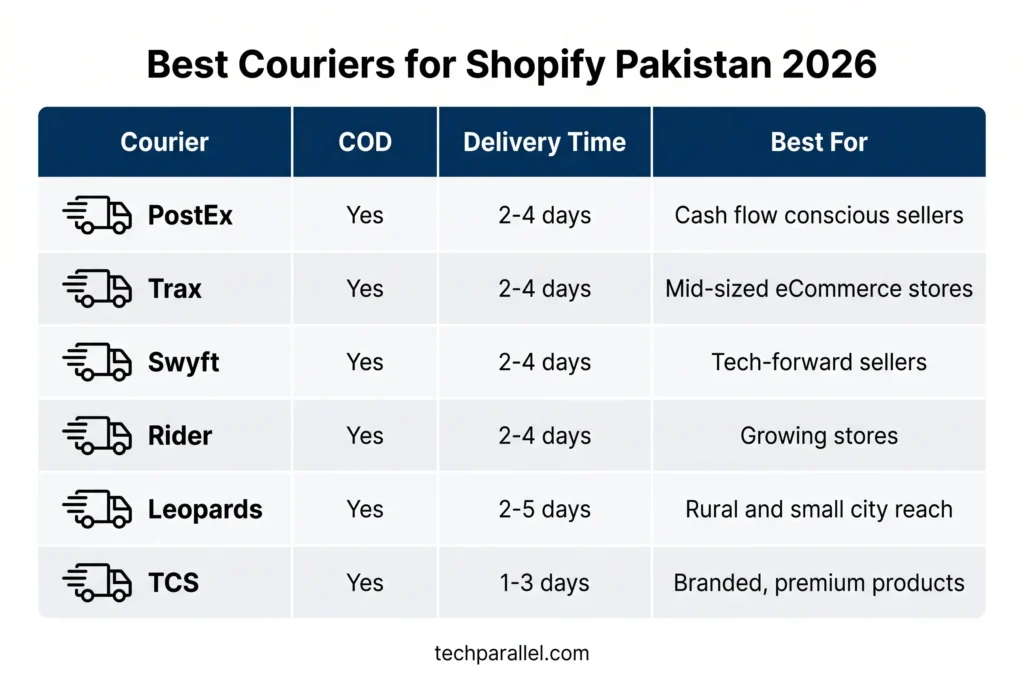
PostEx — The Fintech and Logistics Hybrid
PostEx has become one of the dominant players in Pakistani eCommerce logistics, and for good reason — they offer upfront COD payments, meaning you receive your payment immediately instead of waiting weeks for courier reconciliation. For cash-strapped beginners, this single feature solves one of the biggest cash flow problems in COD-based business.
In 2022, PostEx acquired Call Courier, which is now operating entirely under the PostEx network. If you come across older guides recommending “Call Courier” as a separate option, that information is outdated — it is all PostEx now.
PostEx has an official Shopify app (PostEx Official) that connects directly to your store, allowing automatic order syncing and waybill generation.
Trax — The eCommerce Specialist
Trax is built specifically with eCommerce sellers in mind, offering an excellent API and fast real-time tracking updates. Trax has official Shopify apps including Trax Logistics, Marco, and Sonic available on the Shopify App Store.
Best for: Mid-sized stores that want reliable tracking and a polished customer experience.
Swyft and Rider
Both Swyft and Rider have built tech-forward dashboards with direct Shopify integration plugins, known for fast payout cycles to sellers. These are newer players that compete directly with PostEx and Trax on automation and speed.
Best for: Sellers who want modern dashboard experiences and quick payout turnaround.
Leopards and TCS — The Established Giants
Leopards Courier has the largest nationwide network in Pakistan, making it the most reliable option for reaching customers in smaller cities and rural areas. TCS is the premium option — slightly higher cost but known for reliability, often preferred for higher-value or branded products.
Their technology stacks can lag behind the newer startups, but their physical coverage is unmatched.
Universal Courier Aggregator Apps
If you want to use multiple couriers simultaneously — for example, Leopards for rural coverage and Trax for urban delivery — aggregator apps like Courierify or Universal Courier Pakistan let you connect multiple courier accounts into a single Shopify dashboard. This is a practical solution for sellers who have outgrown a single-courier setup but don’t want to manage separate logins and systems for each one.
Which Courier Should New Shopify Stores Use?
With six solid options, beginners often ask the same question: just tell me which one to pick. Here is a straightforward breakdown based on your order volume:
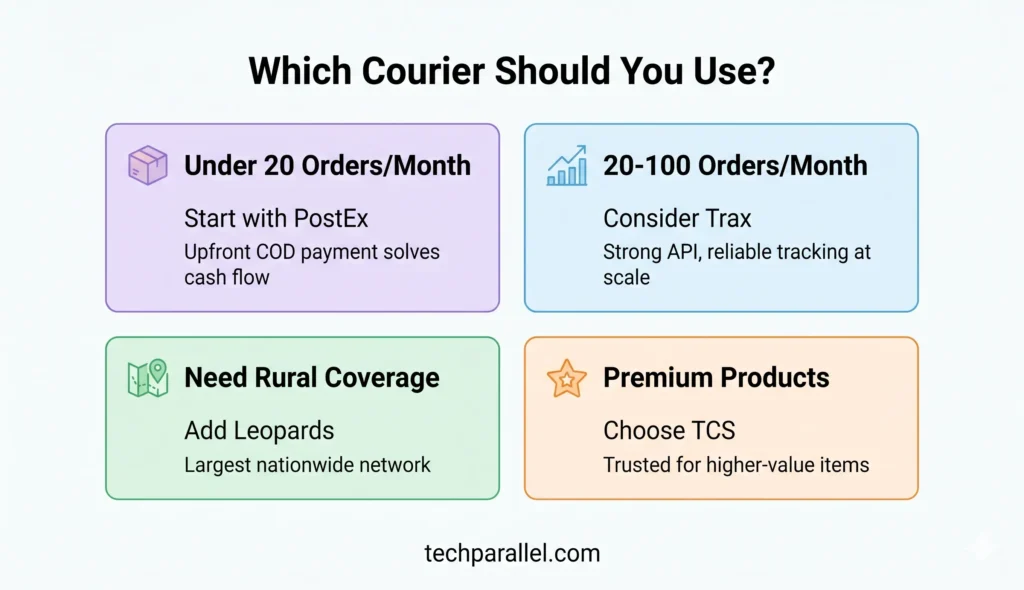
Under 20 orders per month: Start with PostEx. The upfront COD payment model solves your biggest problem at this stage — cash flow. You get paid before the courier even completes reconciliation, which matters enormously when you’re just starting out.
20 to 100 orders per month: Trax becomes worth considering at this volume. Its API and tracking reliability start to matter more as you have more customers to keep updated, and the integration scales well as your order count grows.
Need nationwide coverage, including rural areas: Leopards has the largest network in Pakistan. If your customers are spread across smaller cities and towns, not just Karachi, Lahore, and Islamabad, Leopards delivers where other couriers sometimes don’t.
Selling premium or higher-value products: TCS is the trusted choice for branded or higher-value items where delivery reliability and customer perception matter more than saving a few rupees per shipment.
Most established Pakistani Shopify stores end up using two couriers — one for cash flow and speed (PostEx or Trax), one for broader geographic reach (Leopards). This combination, managed through a universal courier aggregator app, covers both needs without forcing you to choose just one.
How Much Do Shopify Shipping Couriers Charge in Pakistan?
Courier pricing in Pakistan is not a single flat number — it depends on several factors:
Weight — Most couriers charge per kg, with the first kg priced higher and additional weight added incrementally.
Destination — Delivery within major cities (Karachi, Lahore, Islamabad) is generally cheaper than delivery to smaller cities or rural areas.
COD collection fee — Since couriers are collecting cash on your behalf, some charge a small additional percentage or fixed fee for COD handling on top of the base delivery charge.
Monthly volume — Couriers offer negotiated rates for sellers shipping higher volumes. If you’re doing 100+ orders a month, contact your courier directly to negotiate a better rate than their published standard pricing.
As a general guide, expect your total shipping cost per order to fall in the Rs. 150 to Rs. 250 range for standard packages within Pakistan, with COD collection typically adding a small percentage on top. Exact rates vary by courier and change periodically, so confirm current pricing directly with your chosen courier before finalizing your shipping rate strategy.
How to Automate COD Orders — The Modern Workflow
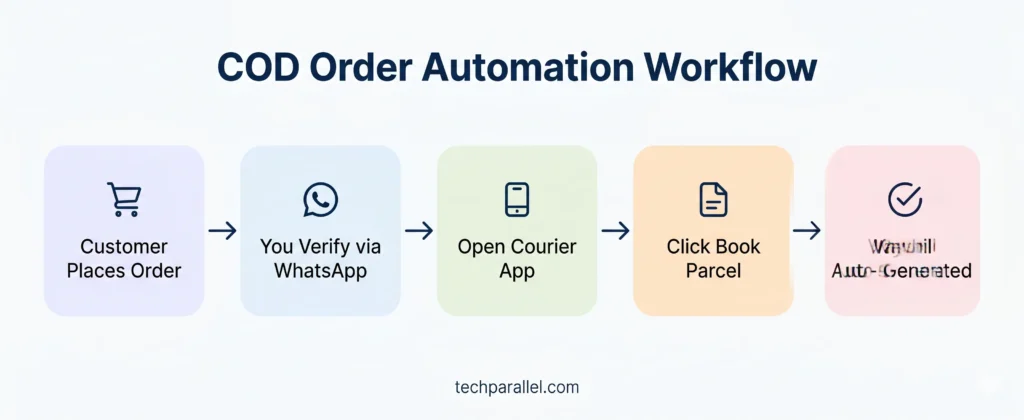
Here is what a properly automated Pakistani Shopify fulfillment workflow looks like in 2026:
- Customer places an order on your Shopify store
- You verify the order via WhatsApp or a phone call — this single step dramatically reduces fake orders
- Open your courier app directly inside Shopify (PostEx, Trax, or whichever you’ve installed)
- Click “Book Parcel”
- The app automatically generates the waybill, marks the order as fulfilled in Shopify, and emails the tracking number to your customer
This entire process takes minutes per order instead of the manual data entry that older guides describe — no copying tracking numbers, no manual fulfillment marking, no separate courier website logins.
For sellers doing 1-2 orders per week while just starting out, manual fulfillment through a courier’s website is acceptable temporarily. But the moment your order volume grows, installing a courier app pays for itself in saved time and reduced errors.
Managing Fake Orders and COD Returns (RTO)
RTO — Return to Origin — refers to orders that are shipped but rejected or refused by the customer at delivery. This is one of the biggest challenges in Pakistani COD-based eCommerce.
Industry estimates suggest an RTO rate of 15% to 30% of COD orders in Pakistan.
This means for every 100 orders you ship, you should realistically expect 15-30 to come back unfulfilled. Planning your margins and cash flow around this reality is essential — many new sellers are caught off guard by how high this number actually is.
Actionable ways to reduce RTO:
WhatsApp confirmation — Before dispatching any COD order, send a quick WhatsApp confirmation message. Customers who don’t respond or confirm are significantly more likely to refuse delivery.
Remove “Buy It Now” shortcuts — Forcing customers through your standard checkout flow rather than an instant buy button reduces impulsive, low-intent orders that are more likely to be refused.
Block repeat offenders — Track customers who repeatedly refuse COD orders and block them from ordering again. Most courier apps and Shopify apps allow you to flag and block specific phone numbers or addresses.
What happens when a COD order is rejected: The courier returns the unsold item to you, and you absorb the shipping cost for both the failed delivery attempt and the return. This is why minimizing RTO directly protects your profit margins.
Shipping Rates Comparison
Frequently Asked Questions
Does Shopify integrate with Pakistani couriers? Yes. Major Pakistani couriers including PostEx, Trax, Swyft, and Rider all offer official Shopify apps that automatically sync orders, generate waybills, and update tracking in real-time. Manual fulfillment is no longer necessary except for very low order volumes.
How much does eCommerce shipping cost in Pakistan? The standard flat rate ranges from Rs. 150 to Rs. 250 per kg, depending on the courier and your negotiated volume as a seller. Most new sellers start with a flat Rs. 200 shipping charge on standard items.
What happens if a COD order is rejected? The courier returns the unsold item to your address, and you absorb the shipping cost for both the failed delivery and the return shipment. This is why reducing RTO through WhatsApp confirmation is important for protecting your margins.
Is Leopards Courier available on Shopify? Yes, Leopards can be connected to Shopify either through their own integration options or through universal courier aggregator apps that combine multiple couriers into a single dashboard.
Is Call Courier still a separate service from PostEx? No. Call Courier was acquired by PostEx in 2022 and now operates entirely under the PostEx network. Any guide still listing Call Courier as a standalone option is using outdated information.
Which courier is best for a new Shopify store in Pakistan? PostEx is a strong starting point for new sellers because of its upfront COD payment model, which solves cash flow problems common to new businesses. As you scale and need broader geographic coverage, adding Leopards for rural reach is a common next step.
Can I offer free shipping on Shopify in Pakistan? Yes, and it’s a proven way to increase average order value. The most common approach is conditional free shipping — for example, free delivery on orders above Rs. 3,000 — rather than free shipping on every order, since shipping costs need to be covered somewhere in your pricing.
Final Thoughts
Don’t run your Pakistani Shopify store on manual fulfillment longer than absolutely necessary. Install PostEx or Trax from day one if your budget allows — the automation saves hours of work per week and significantly reduces the human error that comes with manually copying tracking numbers and order details.
Combine the right shipping zone setup, a flat rate that matches market standards, and an automated courier app, and your fulfillment process will run with a fraction of the manual effort most new Pakistani sellers put into it.
For a complete walkthrough of setting up your entire Shopify store from scratch, read our guide: How to Set Up a Shopify Store in Pakistan — Complete 2026 Guide