Dropshipping in Pakistan with Shopify is not the passive income business that YouTube channels make it look like. The model that works in the US — find a trending AliExpress product, build a Shopify store, run Facebook ads, watch orders roll in — fails completely in Pakistan’s COD-first, trust-sensitive buying environment.
But local dropshipping — partnering with Pakistani suppliers who ship products directly to your customers while you handle marketing and orders — is a real, working business model in 2026. The distinction between these two approaches is the difference between a business that works and one that burns through your budget in two months.
This guide covers exactly how dropshipping in Pakistan with Shopify actually works, which platforms and suppliers to use, what the real costs look like, and the honest profit expectations nobody tells you upfront.
Can You Do Dropshipping in Pakistan with Shopify? — Quick Answer
Yes. Shopify dropshipping works in Pakistan, but not in the way most YouTube videos explain. Instead of relying on AliExpress with 15-30 day delivery times, successful Pakistani dropshippers partner with local wholesalers or suppliers who ship products directly to customers using Cash on Delivery within 2-4 days. This local model maintains COD viability — the foundation of Pakistani eCommerce.
AliExpress Dropshipping vs Local Dropshipping — The Core Difference
Before going into setup steps, understand why this distinction matters for every decision you make.
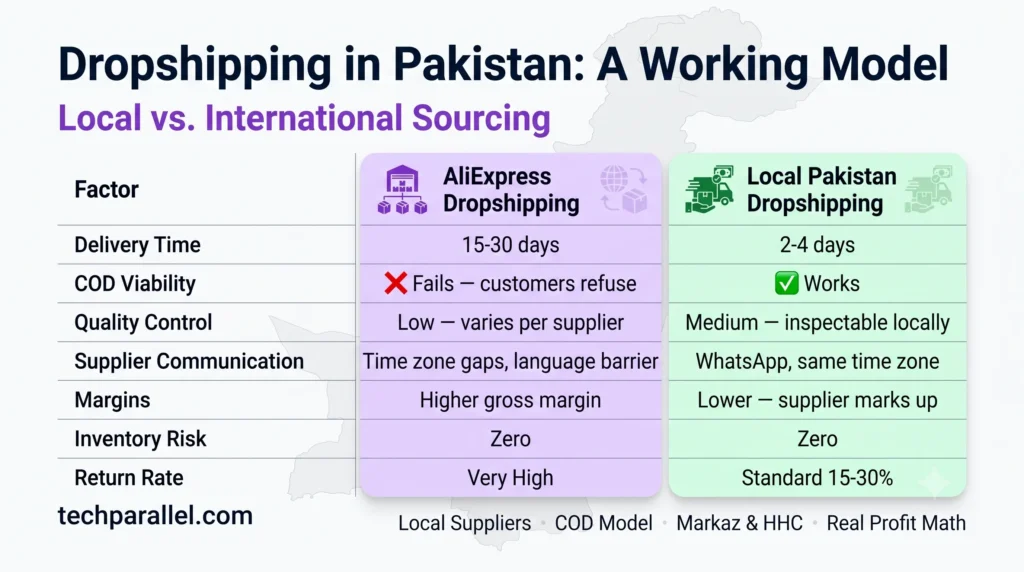
The fundamental problem with AliExpress in Pakistan: A customer who places a COD order and waits 25 days will almost always refuse delivery. They have either forgotten the order, found it elsewhere, or simply lost interest. AliExpress dropshipping has a near-100% COD failure rate at realistic Pakistani delivery timelines.
What Do You Need to Start Dropshipping in Pakistan?
Before jumping into steps, have these ready:
- Laptop or computer with stable internet
- Shopify account — read our guide on Shopify Free Trial in Pakistan
- Pakistani debit card for Shopify subscription — Shopify Pricing in Pakistan
- At least one verified local supplier
- WhatsApp Business account
- Facebook Business page
- Starting budget: Rs. 30,000-50,000 minimum — covering subscription, ads, testing, and initial operations
Be honest with yourself about budget. Starting with Rs. 10,000 means you will run out before you have enough data to make good decisions.
Is Dropshipping Legal in Pakistan?
Yes. Dropshipping is completely legal in Pakistan. There is no specific license required to start a dropshipping business.
Practical realities as you grow:
- Registering as a sole proprietor or private limited company becomes useful for opening business bank accounts and building supplier credibility
- Tax obligations depend on your revenue and business structure — consult an accountant when your monthly revenue exceeds Rs. 100,000
- Some product categories have regulatory requirements regardless of business model — medicines, supplements, and certain food products require compliance regardless of whether you dropship or hold inventory
How to Choose Your Niche —Step 1
Niche selection matters more in dropshipping than in inventory-based models because your margins are already thinner — you need a product category where the markup covers supplier cost, courier, marketing, gateway fees, and still leaves meaningful profit.
Best niches for Pakistani dropshipping in 2026:
- Perfumes and fragrances — high perceived value, lightweight, low returns
- Islamic products — low competition, low return rate, year-round demand
- Skincare and beauty — repeat purchase, TikTok-driven demand
- Home decor — visually driven, lightweight options available
- Kids products — gifting occasions, low return rate
Avoid for dropshipping specifically:
- Electronics — warranty complications you cannot handle without inventory
- Clothing — sizing issues create unmanageable return rates when you cannot inspect products
- Heavy items — shipping cost destroys already-thin dropshipping margins
For a complete product category analysis with margin calculations, read our guide on Best Products to Sell on Shopify in Pakistan.
How to Find Pakistani Dropshipping Suppliers —Step 2
This is where most beginner guides fail — they say “find suppliers” without explaining how. Here are the actual approaches that work in Pakistan.
Local Dropshipping Platforms
Several Pakistani platforms have emerged specifically to connect Shopify sellers with local suppliers:
HHC Dropshipping — One of the more established Pakistani dropshipping platforms with Shopify integration capabilities. Allows sellers to list products and have suppliers fulfill directly. (HHC Dropshipping)
Markaz App — Primarily designed for social sellers but also serves Shopify-connected merchants. Strong for fashion and lifestyle categories.(Markaz App)
Zarya — Another local platform connecting resellers with suppliers across product categories.
Verification note: Check current Shopify integration status of each platform before committing — these platforms update their features regularly.
Private WhatsApp Supplier Groups
A significant portion of Pakistani dropshipping happens through private WhatsApp groups where wholesalers share their catalogs, prices, and dropshipping terms. These groups are found through:
- Facebook groups for Pakistani eCommerce sellers
- Recommendations from other sellers in online communities
- Direct outreach to wholesalers on Daraz who also offer dropshipping
Wholesale Markets — Direct Approach
Going directly to wholesale markets and negotiating dropshipping arrangements gives you better margins than platform-based suppliers, but requires relationship building.
Key wholesale markets:
- Faisalabad — Fabric, unstitched suits, clothing
- Lahore (Shah Alam Market) — General wholesale, clothing, accessories
- Karachi (Boulton Market, Tower Market) — Diverse categories including perfumes, Islamic products, accessories
- Sialkot — Sports goods, leather products
Supplier Types and What to Expect
| Supplier Type | Margins | MOQ | Reliability | Best For |
| Manufacturer | Highest | High | Variable | Established sellers |
| Wholesaler | Good | Low-Medium | Good | Starting out |
| Distributor | Medium | Low | High | Branded products |
| Dropship Platform | Lowest | None | Variable | Absolute beginners |
How to Spot Fake Suppliers
This section protects you from the most common dropshipping trap in Pakistan.
Red flags — walk away immediately:
- Asks for large upfront “registration fees” before showing catalog
- Refuses video call or in-person meeting
- No verifiable physical address
- Product photos are clearly stolen from Daraz or AliExpress listings
- Promises profit margins that seem impossibly high (50%+ on common products)
- No real WhatsApp business profile — just a personal number
- Cannot provide sample products before committing
Green flags — supplier worth working with:
- Has existing Daraz store with reviews you can verify
- Willing to send a sample at cost
- Provides clear dropshipping terms in writing
- Has consistent catalog with realistic pricing
- Communicates promptly and professionally
How to Set Up Your Shopify Store —Step 3
For a complete walkthrough of store setup, read our How to Set Up a Shopify Store in Pakistan guide. For dropshipping specifically, pay attention to these settings:
Inventory tracking: Turn off inventory tracking for dropshipped products — you do not control stock levels, so you cannot accurately track them. Set products to “continue selling when out of stock” and manage availability manually based on supplier updates.
Product descriptions: Do not use your supplier’s descriptions — every other dropshipper has the same text. Rewrite descriptions with your brand voice. Use ChatGPT for Shopify to generate unique descriptions quickly.
Product photography: If your supplier’s photos are weak, consider ordering one sample and photographing it yourself. Original photos differentiate your store significantly.
Essential apps for dropshipping stores: Read our Best Free Shopify Apps for Pakistani Stores guide — specifically the COD form builder and WhatsApp chat app sections, which are critical for dropshipping conversion.
Setting Up Payments and Shipping —Step 4
For dropshipping, COD is your primary payment method — it removes the trust barrier that prevents first-time customers from ordering.
Set up your payment methods following our Best Payment Gateways for Shopify in Pakistan guide. For dropshipping specifically, also add bank transfer as a secondary option for customers who prefer it.
For shipping, since your supplier is fulfilling orders, your shipping setup is primarily about setting correct delivery time expectations. Set your shipping zone to Pakistan with honest delivery timelines — “3-5 business days” is more accurate for dropshipping than “2-3 days” because you have less control over dispatch speed.
Read our complete Shopify Shipping Setup Pakistan guide for zone configuration.
Market Your Dropshipping Store —Step 5
The most effective marketing channels for Pakistani dropshipping stores ranked by beginner suitability:
| Method | Beginner Friendly | Cost | Speed to Results |
| TikTok Organic | ⭐⭐⭐⭐⭐ | Free | Medium |
| Instagram Reels | ⭐⭐⭐⭐ | Free | Medium |
| Facebook Ads | ⭐⭐⭐ | Medium | Fast |
| WhatsApp Broadcast | ⭐⭐⭐⭐⭐ | Free | Fast |
| Micro-influencers | ⭐⭐⭐ | Low-Medium | Fast |
| SEO/Blog | ⭐⭐ | Low | Slow |
The most effective paid strategy for Pakistani dropshipping in 2026:
Meta (Facebook/Instagram) ads with location targeting to urban Pakistani cities, driving traffic into a WhatsApp Business integration rather than directly to checkout. The flow works like this:
Customer sees ad → Clicks “Send Message” → Lands in your WhatsApp → You confirm COD order → Manual order placed in Shopify → Supplier dispatches
This WhatsApp-first funnel converts better for new stores because it adds human trust before the purchase commitment — critical when customers have never heard of your brand.
Startup Cost Breakdown
| Expense | Estimated Cost |
| Shopify Basic (1 month) | Rs. 11,000 |
| Domain name | Rs. 4,000/year |
| Logo (Canva free) | Rs. 0 |
| Product samples for photography | Rs. 3,000-5,000 |
| Facebook/Instagram ads (testing) | Rs. 20,000 |
| Packaging materials | Rs. 2,000-3,000 |
| Miscellaneous | Rs. 5,000 |
| Total minimum | Rs. 45,000-48,000 |
This is a realistic starting budget for someone serious about validating a dropshipping business. Under-budgeting is the most common mistake — stopping ads before you have enough data to optimize is worse than not starting.
Honest Profit Expectations
Here is what the numbers actually look like for local Pakistani dropshipping:
Example — Dropshipping a Rs. 2,500 perfume:
| Item | Amount |
| Selling price | Rs. 2,500 |
| Supplier cost (dropship price) | Rs. 1,400 |
| Courier cost | Rs. 220 |
| Packaging | Rs. 80 |
| Gateway fee (2.85%) | Rs. 71 |
| Marketing cost per order | Rs. 250 |
| Gross profit per delivery | Rs. 479 |
At 20% RTO rate, your net profit per order placed is approximately Rs. 383.
The honest reality: Local dropshipping margins are 15-20% lower than if you bought the same inventory directly from the wholesale market. The supplier marks up their price for the dropshipping convenience. At Rs. 383 net profit per order, you need 100+ orders per month to generate meaningful income after your Shopify subscription.
At what volume does dropshipping become viable:
| Monthly Orders | Gross Revenue | Net Profit (approx) |
| 30 | Rs. 75,000 | Rs. 11,490 |
| 60 | Rs. 150,000 | Rs. 22,980 |
| 100 | Rs. 250,000 | Rs. 38,300 |
These numbers assume consistent RTO rates and marketing costs — both variable in practice.
Can Shopify Dropshipping Be Automated in Pakistan?
Partially. Here is what can and cannot be automated in the Pakistani dropshipping context:
Can be automated:
- Order notifications to supplier via WhatsApp (partially, with Business API)
- Courier booking once order is confirmed (via PostEx/Trax apps)
- Customer tracking updates (via courier app integration)
- Abandoned cart follow-up messages
Cannot be easily automated:
- COD order verification — human call or WhatsApp confirmation reduces fake orders
- Supplier inventory sync — most Pakistani suppliers do not have real-time inventory APIs
- Quality control — no automation replaces physically checking products
The realistic expectation: your dropshipping business will require 2-3 hours of daily management at 30-50 orders per month. It is not passive income.
Common Mistakes Pakistani Dropshipping Sellers Make
Relying on AliExpress — Already addressed. This model does not work for COD Pakistan delivery timelines.
Not verifying supplier before committing — One bad supplier who sends wrong or damaged products creates returns, negative reviews, and wasted courier costs.
Underpricing — New sellers price products too low, not accounting for RTO impact, marketing costs, and gateway fees. Run the profit formula before setting your price.
Buying too many products from supplier before validation — Even in dropshipping, some sellers pre-buy inventory “just in case.” Test demand before committing.
Ignoring product quality control — Without holding inventory, quality issues only surface through customer complaints. Order samples before listing, and stay in close communication with your supplier about quality consistency.
Dropshipping vs Own Inventory — When to Switch
Start with dropshipping to validate your product and market. The zero-inventory-risk model is ideal for testing whether customers want what you are selling before committing capital.
Switch to own inventory when:
- You have validated consistent demand — 60+ orders per month for the same product
- Your supplier’s dropship margin is noticeably hurting profitability
- You want better quality control and faster dispatch times
- You are ready to build a brand rather than just sell products
The typical progression for successful Pakistani eCommerce sellers: Start dropshipping mobile accessories or perfumes → validate 2-3 winning products → buy small wholesale inventory (50-100 units) of proven products → build brand identity around those products → scale with own inventory while potentially still dropshipping newer, unproven additions.
Is Shopify Dropshipping Still Worth It in Pakistan in 2026?
Reasons it is worth it:
- Zero inventory risk — test products without committing capital
- Fast to launch — store can be live in days, not weeks
- Easy to pivot — change products without being stuck with dead stock
- Low barrier to entry — most accessible eCommerce model for beginners
Reasons it is not easy:
- Margins are thinner than own-inventory models
- Supplier dependence — their quality, stock, and dispatch speed affects your reputation
- Quality control is difficult without holding products
- Increasing competition — more Pakistani sellers are doing this every month
- Requires consistent marketing investment — not passive income
Honest verdict: Dropshipping in Pakistan is worth starting as a learning model and product validation tool. Most sellers who succeed long-term transition to at least partial own-inventory once they have identified winning products. Treat dropshipping as phase one, not the final destination.
Frequently Asked Questions
Is dropshipping legal in Pakistan?
Yes. Dropshipping is completely legal in Pakistan with no specific licensing requirement. As your business grows, registering as a sole proprietor or company becomes useful for banking and supplier credibility.
Can I do dropshipping from AliExpress in Pakistan?
Technically yes, but practically it fails. AliExpress delivery times of 15-30 days are incompatible with Pakistan’s COD model — customers refuse delivery after waiting that long. Local Pakistani suppliers with 2-4 day delivery are the working alternative.
How much money do I need to start dropshipping in Pakistan?
A realistic minimum is Rs. 30,000-50,000 covering Shopify subscription, domain, product samples, initial ads, and packaging. Starting with Rs. 10,000 typically means running out of budget before generating useful data.
Which products are best for dropshipping in Pakistan?
Perfumes, Islamic products, home decor, and skincare perform well for dropshipping because they combine reasonable margins, lightweight shipping, and low return rates. Avoid clothing (sizing returns) and electronics (warranty complications).
How do I find dropshipping suppliers in Pakistan?
Start with local dropshipping platforms like HHC Dropshipping or Markaz App for easiest onboarding. For better margins, approach wholesale markets in Faisalabad, Karachi, and Lahore directly and negotiate dropshipping arrangements with wholesalers.
Can I use COD for dropshipping in Pakistan?
Yes — COD is the primary payment method for Pakistani dropshipping. Your supplier dispatches the order and your courier collects cash at delivery. Set up COD in Shopify under Settings → Payments → Manual payment methods.
Is Shopify better than Daraz for dropshipping in Pakistan?
For building a brand and keeping full margins, Shopify is better. Daraz’s commission structure (15-25% combined fees) is particularly damaging for dropshipping where margins are already thin. Read our complete Shopify vs Daraz comparison for the full breakdown.
Do I need a business registration to start dropshipping?
No registration is required to start. Register when you are generating consistent revenue and need business banking, or when your supplier requires it for wholesale pricing.
Final Thoughts
Dropshipping in Pakistan with Shopify works — but only the local model. The AliExpress approach that works in Western markets fails here because Pakistan’s COD-first buying behavior requires delivery timelines that international suppliers cannot meet.
Start with one supplier, one product category, and a realistic budget. Validate demand before scaling. And treat the thin margins honestly in your planning — dropshipping is a starting point, not a long-term margin strategy for most sellers.
For your complete Shopify store setup before launching your dropshipping business, read our guide: How to Set Up a Shopify Store in Pakistan — Complete 2026 Guide